What Three Years of Catering SEO Actually Taught Us
Kent Sheridan, Zane & Gvantsa✦August 25, 2026✦1:21:00
Over 95% of our clients’ leads come from Google. Under 10% come from Instagram, and that holds true even for the clients with tens of thousands of followers. That single split is the reason this podcast exists, and it is the thread running through the whole first episode.
Kent, Zane, and Gvantsa sat down for an hour and twenty minutes to talk about what changed in catering SEO between 2023 and now: what used to work, what stopped working, what we got wrong, and the handful of things that still move rankings faster than anything else. Below is the full episode, the short version of every lesson in it, and an abbreviated transcript.
The short version
If you only read one part of this page, read this.
- Google is the lead source. Instagram is the brochure. Our client data puts over 95% of inbound leads on Google, and that includes clients with large, genuinely good Instagram accounts.
- Your website is not a portfolio piece. It is the storefront. Kent spent close to a decade treating a website like a business card and lost years of bookings to that assumption.
- Events are the business, not the bonus. If you are running farmers markets and treating catering inquiries as upside, you have the model backwards.
- The H1 is the fastest fix on most sites. Fixing the H1 alone has moved sites from page three to page one. It should answer three questions: what you do, who you do it for, and where.
- Reviews compound on cadence, not volume. Thirty reviews arriving weekly beats fifty that stopped a year ago.
- Corporate beats weddings on repeat value. A wedding is one event. A corporate client can be quarterly, sometimes monthly, and the average ticket is often higher.
- AI-generated city pages are a liability. Duplicated location pages get ignored or suppressed, and the recovery can take six months or more.
- The market is not open anymore. Three years ago the pitch was “nobody here is doing SEO.” Now the question is whose SEO is better.
- Everyone writes the same headline. “Elevate your event” is on a startling number of catering sites. If your copy could belong to any competitor, it is not doing SEO work or brand work.
Why Google beats Instagram for catering leads
This was the most contested point three years ago and it is close to settled now. Caterers used to arrive at a sales call genuinely torn between putting money into social and putting money into their site.
The data ended that argument. Across our client base, over 95% of inbound leads come from Google, self-reported by the customer on the inquiry form and confirmed in analytics. Clients with strong Instagram followings still see under 10% of leads originate there. A following is not a pipeline.
The structural reason is intent. Someone scrolling Instagram is not trying to book a coffee cart for a 200-person sales kickoff in eleven days. Someone typing “coffee catering Chicago” is. Around 75% of Google traffic goes to the top three results, so the gap between position two and position seven is not incremental, it is most of the market.
If your site is invisible and you cannot work out why, the three most common causes are covered in our breakdown of why mobile caterers get zero leads from Google.
What actually changed between 2023 and now
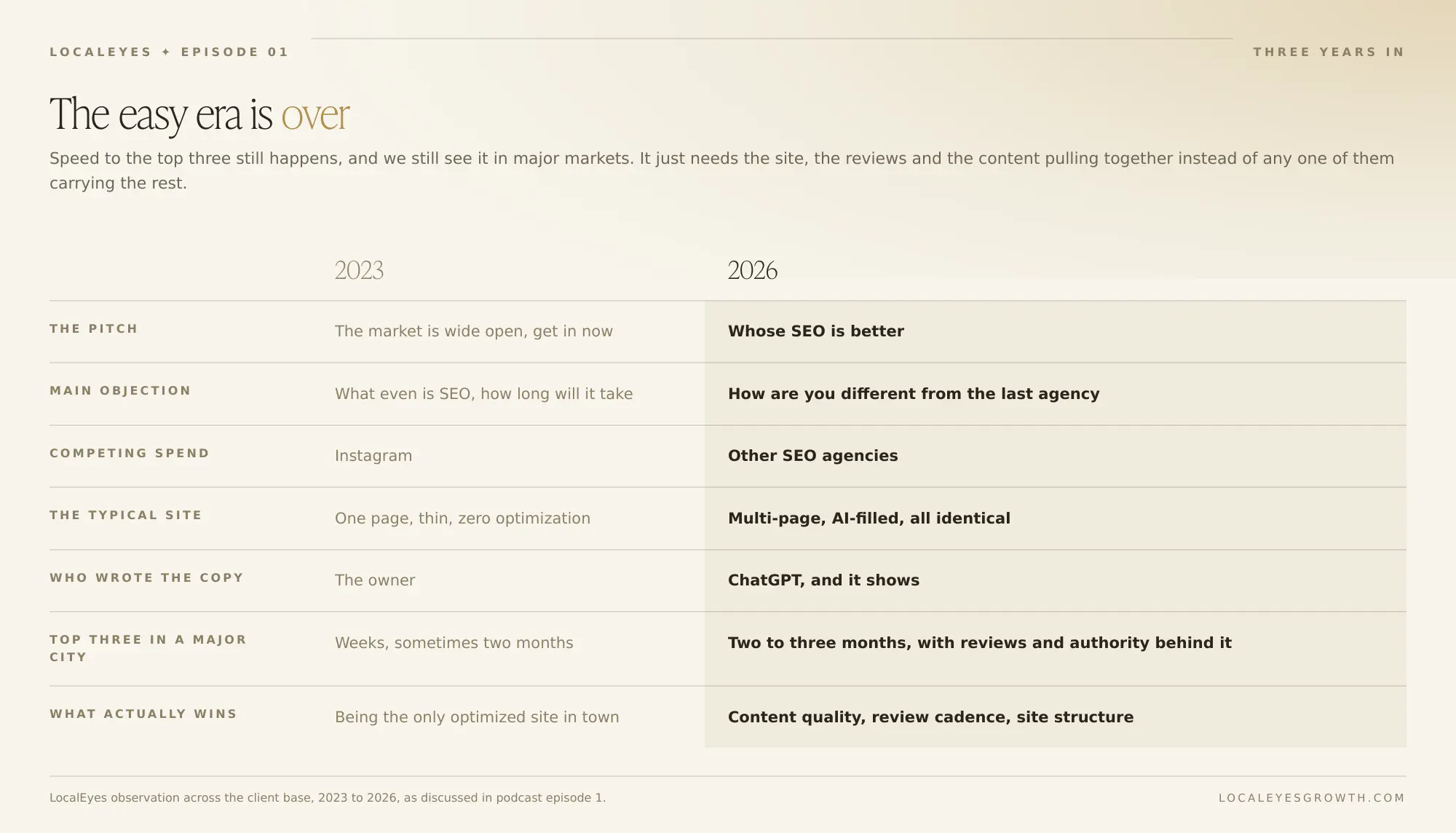
| 2023 | 2026 | |
|---|---|---|
| The pitch | “The market is wide open, get in now” | “Whose SEO is better” |
| Main objection | “What even is SEO, how long will it take” | “How are you different from the last agency” |
| Competing spend | Other SEO agencies | |
| Typical site | One page, thin, zero optimization | Multi-page, AI-filled, all identical |
| Copy | Written by the owner | Written by ChatGPT, and it shows |
| Time to top 3 in a major city | Weeks, sometimes 2 months | Still possible in 2 to 3 months, but only with authority and reviews behind it |
| What wins | Being the only optimized site in the city | Content quality, review cadence, site structure |
The uncomfortable version of that table: the easy era is over. Speed to top three still happens, and we still see it in major markets, but it now requires the site, the reviews, and the content working together rather than any one of them carrying the rest.
The three W’s: how to write an H1 that ranks
Gvantsa’s answer to “what is the first warning sign on a site that gets no leads” was immediate: the H1. Either it is not marked up as an H1 at all, or it is marketing copy that says nothing Google can use.
The formula is three questions, answered in one line:
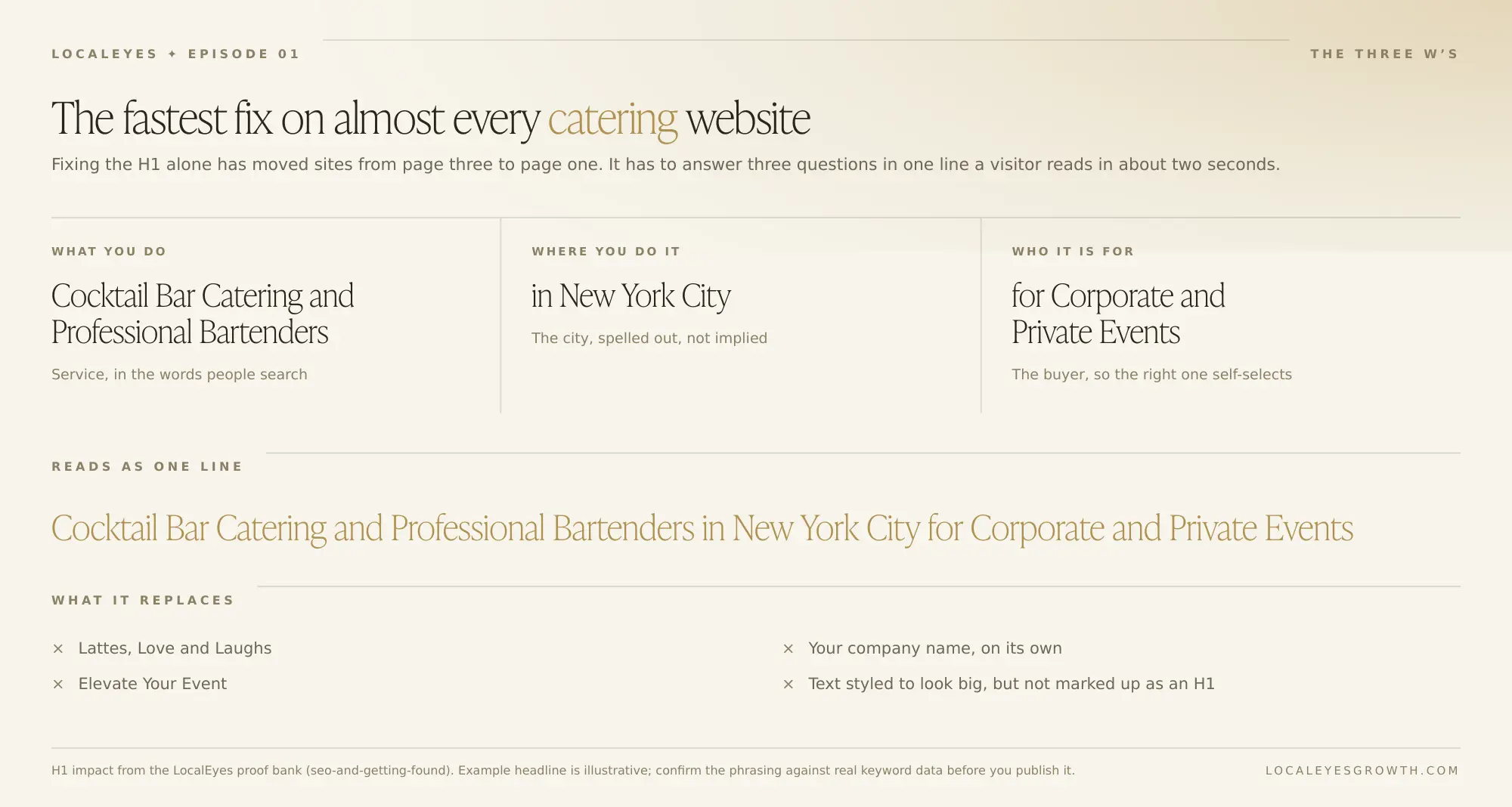
Worked example — a mobile bar in New York
“Cocktail Bar Catering and Professional Bartenders in New York City for Corporate and Private Events.”
It is not poetry. It fits above the fold, it carries the keyword, and a visitor understands the business in about two seconds.
What it replaces is the thing almost every catering site starts with: a company name as the H1, or something like “Lattes, Love and Laughs.” Fixing the H1 alone has been enough to move a site from page three to page one, which makes it the highest return-per-minute change on this list.
The rest of the above-the-fold checklist
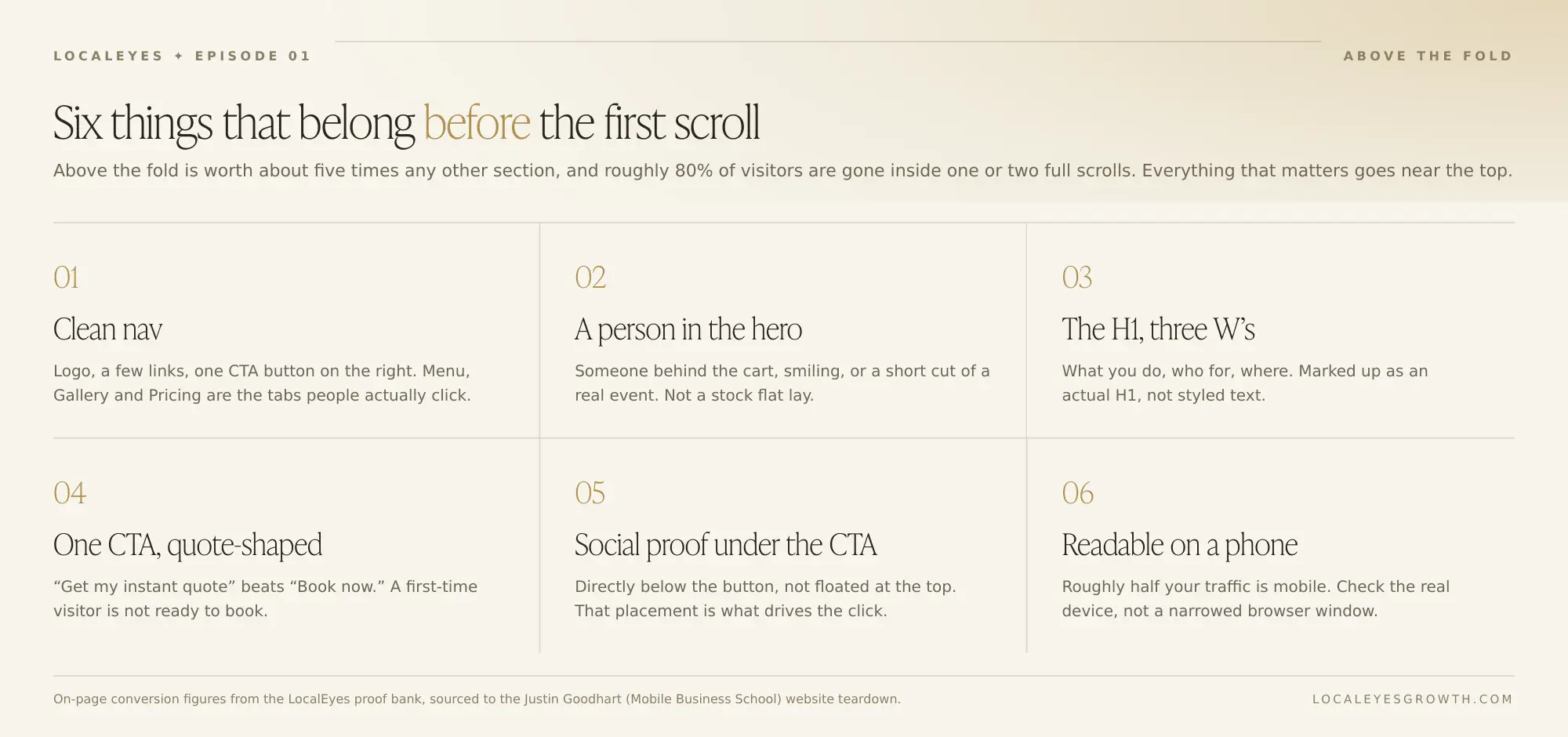
Above the fold is worth roughly five times any other section of the page, and around 80% of visitors leave within one to two full scrolls. Everything that matters goes near the top.
Does SEO clash with branding?
Almost everyone assumes it does. It does not, and the reason is mechanical rather than philosophical.
Take the extreme case. You build a page optimized purely for a crawler, with no design and nothing that convinces a human you can actually run their event. It might rank briefly. Then visitors land, bounce straight back to the search results, and Google reads that behavior as a signal that the page did not answer the query. The ranking goes with it.
So a badly designed site eventually damages the SEO that got it ranked. The order of operations matters more than the tradeoff: get people to the site first, then obsess over the last three pixels. If nobody is landing, the design is not making you money either way.
The review engine
Zane’s answer to “what separates the businesses that grow from the ones nobody finds” was fresh content and consistent reviews, in that order of how often it gets ignored.
The part most operators miss is that cadence beats volume. A profile sitting at 30 reviews that adds one every week will typically pass a profile stuck at 50 that stopped a year ago, and it will often pass it before it reaches 50 itself. Google is reading the pattern, not just the count.
The practical move is to build review collection into the event instead of chasing it afterward:
| Tactic | Where it happens | Why it works |
|---|---|---|
| A-frame sign at the front of the queue | At the cart, during service | People in line are standing still with a phone in hand. It is free real estate. |
| Secret menu item for a review | At the point of order | Converts a request into a small trade rather than a favor |
| “Every review tips our baristas” | Corporate events with no tip jar | Corporate hosts often ban tip jars. This routes the same generosity somewhere useful. |
| One staff member making the ask out loud | Mid-service, when a queue forms | “Our goal tonight is ten reviews with a photo, I will pose” converts far better than a card |
| Weddings specifically | Any wedding booking | Operators across the country are seeing unusually high review rates at weddings right now. Guests are relaxed and want to support the vendors. |
Under five or ten reviews, a single one-star does real damage. That is the other reason to start the engine early rather than after the first bad night. More on how reviews and rankings interact in why Google reviews outrank your website.
Why DIY AI SEO is not ranking
This came up as its own segment and it is the most current problem on the list. An operator asks ChatGPT or Claude how to optimize their site, does everything it says, checks every box, and does not move.
Two reasons, both structural.
The first is bad keyword input. AI models pull their sense of a market largely from what is already ranking. If the caterers in your city all have the wrong keywords in the wrong places, that is the pattern the model learns and hands back to you. It will confidently tell you to put the wrong term in your H1 because the wrong term is what it saw.
The second is duplication at scale. The most common DIY move is generating one location page and cloning it across twenty cities with the city name swapped. Google indexes some, ignores most, and in the worst cases effectively suppresses the whole domain for duplicate content. It does not send a notice. Recovery runs six months or longer.
Two tests for any location or service page you have already published:
- Is it linked from somewhere else on your site? An orphan page is a page Google has no reason to trust.
- Does it outrank your own home page for the query it was built for? If your home page still comes up first for “coffee catering Austin,” the Austin page did nothing and is costing you crawl budget.
If a page fails both, delete it. The full structural approach lives in our complete local SEO guide for mobile caterers.
What we got right, and what we would tell a caterer starting tomorrow
The results we can point to: a client who went from 4 leads to 34 in two months, top-three positions in NYC, Philadelphia, Orlando, Chicago and Los Angeles, and a Los Angeles coffee caterer who hit number one for their money keyword inside two months and held it while the market got significantly harder around them.
The result Kent likes most is different. A New York operator who was already ranking, already making good money, already near the top of page one for three keywords. The work was not fixing anything broken. It was finding the ten keywords she was not ranking for at all. Her revenue roughly doubled. Being number one for the two keywords you happen to check is not the same as owning your market.
And the closing advice, unedited in spirit: get the website. Do not run your business on Instagram alone. Build every channel that can bring you a lead, then grow them one at a time.
Episode chapters
| Time | Topic |
|---|---|
| 0:00 | Intro and what this episode covers |
| 2:16 | Where the name LocalEyes came from |
| 3:10 | Kent’s failed coffee cart and what it taught him |
| 7:37 | The one thing he wishes someone had told him |
| 9:17 | Selling SEO to coffee caterers in 2023 |
| 12:32 | Instagram versus Google, and how that argument ended |
| 15:25 | “Elevate your event” and why every site reads the same |
| 17:05 | Pushing the industry toward corporate events |
| 20:18 | What caterers get wrong about communicating their business |
| 23:27 | Why we expanded past coffee catering |
| 25:06 | Breaking into New York, Chicago, Miami and Dallas |
| 29:06 | Site structure: service pages and location pages |
| 30:15 | The hero section, line by line |
| 33:38 | Fresh content and the review cadence |
| 35:27 | Building a review engine at the cart |
| 39:38 | The visuals trap |
| 41:44 | The first warning sign on a site with no leads |
| 43:35 | The three W’s H1 formula |
| 45:25 | Does SEO clash with branding |
| 47:36 | Why DIY AI SEO does not rank |
| 50:50 | Duplicate city pages and getting suppressed |
| 52:54 | Client results, named cities and timelines |
| 58:42 | The New York client who doubled revenue |
| 1:04:19 | The new site and the free Growth Assessment |
| 1:07:23 | The coffee catering price calculator |
| 1:09:31 | The catering knowledge base agent |
| 1:11:38 | Client dashboards and why we run on group texts |
| 1:13:48 | Rapid fire |
| 1:20:47 | One piece of advice for someone starting tomorrow |
Abbreviated transcript
Lightly edited for readability. Timestamps are approximate.
On where the name came from (2:16)
Kent: It came from not overthinking it. I have gotten stuck naming companies before. Local SEO, local attention, local traffic, LocalEyes. I told Zane we would call it that and come up with something better later. We never did.
Zane: The local part came from wanting to start with local businesses, because jumping straight to anything grander would have been very hard. The “eyes” part is just visibility.
On the coffee cart that failed (3:39)
Kent: I would not really call it a business. It was me failing completely at having a coffee cart. What it taught me was how to present yourself online, because I did not. I did farmers markets like everyone did before event catering became a thing. Then I did one wedding, one event, and thought, this is so much easier, getting paid up front. It still did not click that it was the business.
I also ran an online coffee company for six years and did everything wrong there on SEO too. So I get to talk to people in the coffee and cafe space and say honestly, I was in your shoes.
Gvantsa: How often on a call do you think, I have been in exactly this position?
Kent: As soon as I hear the words farmers market. You have a mobile setup that was never built to be mobile, the plumbing shakes loose, the circuit trips, and then you stand in a booth for eight hours hoping someone walks by. At some point you are faking a smile watching people pass. There is a better way, and it is more profitable and it does not drain you.
On what he wishes someone had told him (7:37)
Kent: Events and catering are the business, not the bonus. I was treating an event inquiry as a nice surprise while my main gig was standing on a corner in Bend, Oregon for seven hours to sell three drinks.
And take the website seriously. For almost a decade I thought a website was a portfolio piece, something to look cool and represent the brand. It is the new version of Main Street. People used to fight over the best storefront on the block because that is where everyone walked past. Your website is that.
On selling SEO three years ago (9:17)
Zane: People were hesitant because they were not making much money yet. The gate you had to open was showing them what organic leads could return. Most of them had genuinely average websites with zero optimization. Once they heard the market was wide open in their city and they could be found for conferences and corporate events, they would take the shot.
Kent: I was on those calls. The pushback then was different. People questioned what SEO even was. It was not part of the standard blueprint for caterers. And Instagram came up constantly, people deciding between social and their site. It took time before people understood Instagram was a vanity metric, not a lead engine.
On the Instagram question today (17:26)
Kent: The other day I still had someone on a sales call who thought Instagram could be a major lead source. I have the data. Over 95% of our clients’ leads come from Google. The customers say they came from Google. These are clients with genuinely great Instagram accounts and big followings, and it is still under 10% of leads. A big following does not mean those people are your customers.
On pushing the industry toward corporate (18:40)
Kent: Weddings are easier to get, but if you tailor your services and your site to appeal to high-end corporate clients, your average ticket can double and the gigs get bigger. Two and three day events. Repeat clients. With a wedding you get one wedding. We have clients running quarterly events with the same corporate account, and some doing monthly coffee service in offices.
Zane: We try to put these businesses in front of event planners specifically. That is a segment we learned how to be visible to. A planner is not one event, it is a stream of them.
On what caterers get wrong (21:38)
Gvantsa: We call ourselves SEO specialists but we do more growth marketing. We work on conversion rates, design, and consulting on the business, and we do not consider a client successful just because traffic went up. We track leads.
The thing most people get wrong is communication. It is one thing to bring a user to your site and another to give them the information they need. You see these one-page sites cramming everything into a single place. What you do, what it costs, what you specialize in. Users have to get that as fast as possible.
On the hero section (30:15)
Zane: Start at the top. Clean logo, a few links, CTA button on the right. Most sites have that already. Then the hero. Something inviting where somebody can picture you at their event. A person, a smile, a person behind the cart, even a short video. Text next to it, and an H1 that is properly optimized, because that is the first thing Google latches onto.
Gvantsa: The hero matters because it cannot be crowded and it cannot be exhausting. You have to hand-pick what goes there. Users are lazier than you think and they will not dig through your site for the thing you needed them to see. Our whole job in that space is moving someone from “I am interested” to “I have to reach out.”
On reviews and fresh content (33:38)
Zane: Fresh content, consistently. Updates, event photos, and reviews on Google. The way Google reads reviews together with your site has completely changed. If you have a profile stuck on the same reviews for three months, and someone else with a worse site is getting reviews steadily, Google puts those two things together and moves them up past you.
Kent: Let me drop some gold. When Valor started taking catering seriously I was using their headquarters as my office, sitting next to Joey, and I said we need a review engine. Buy a stand that goes in front of the cart. There is a line at every event. That is free real estate. Ask for the review right there, and incentivize it. A secret menu item. Or instead of a tip jar, every review tips our baristas, which matters because a lot of corporate hosts do not want a tip jar out.
If you have three staff and a queue, one person can look up and say, our goal tonight is ten reviews with a picture, I will pose. Bring energy to it. Nobody responds to “can you leave us a review.”
And the cadence matters more than the count. If you are at 30 and getting one a week, you will jump the person sitting at 50 before you even reach 50 yourself.
On the visuals trap (39:38)
Gvantsa: Visuals are good and necessary, but they do not bring you leads. A lot of clients direct us to work on visuals, and we are happy to, we build sites that convert. Coffee catering is a visual business. But what brings the leads is well-structured, useful content, correct headers, and the technical work underneath.
My opinion is bring people to the site first, then work on how it converts. Caterers focus on visuals partly because it is the most tangible thing they can see. The technical work is invisible.
It is like having an amazing restaurant in the middle of nowhere that nobody can find.
On the H1 (41:44)
Gvantsa: We had one client with a beautiful site built in JavaScript, which is not SEO friendly and they had no way of knowing that. But other than that, it is always the H1. Either the text is there but not marked up so Google does not recognize it as the main header, or it is catchy marketing copy with no keyword and no description in it. When I see that, I know a correct header will produce an increase fairly soon. It is a quick win, and then you find the next thing.
The formula is what you do, who you do it for, and where. Three W’s, answered immediately. For a cocktail catering business in New York, something like cocktail bar catering and professional bartenders in New York City for corporate and private events. Not too long, fits on screen, delivers everything.
Kent: People get romantic about their copy. That is how you end up with “Lattes, Love and Laughs” as an H1, or just the company name. First get people to the site. Then make it cool.
On SEO versus branding (45:25)
Kent: Everyone thinks they clash. There is a middle. Take the extreme: a technically perfect site that is impossible to use. It will never book anyone, and then it actually hurts your SEO, because time on site goes to zero. Google watches people click your link and bounce straight back to the results, and stops recommending you. So they go hand in hand. You can over-optimize and play the game, but it has to be built for humans or it drops.
On DIY AI SEO (47:36)
Gvantsa: Wrong keywords, first. AI gets its data from what is already on Google. If the businesses in your market are not optimized, the model has learned the wrong patterns and hands them back to you.
Second, duplication. All of that content looks the same. If it is exhausting for me it is exhausting for users. Google does not keep those pages to show anyone. They exist in your sitemap and serve no purpose.
Zane: Two tests for one of those pages. It should be linked from somewhere else on your site. And it should come up above your home page for the thing it is about. If your home page is still ranking for that query instead, what was the page for?
Gvantsa: A whole site can effectively get hidden for duplicate content. Google will not tell you. The recovery can take six months or more. You can have a perfectly optimized page, fresh reviews, no reason not to be number one, and the rest of the site is what is holding it down.
On results (54:14)
Zane: Number one spots in LA, Chicago, New York, Miami and a couple of big Texas cities. Early on, clients making jumps within one or two months in major markets and holding them. We still see top three and top five inside two months when the site has authority, consistent reviews, and is not a brand new domain.
Kent: One of our first LA clients hit number one for coffee catering in Los Angeles within about two months and stayed with us for years while that market got significantly harder.
The one I like most is a New York operator I reached out to personally. Before the call I thought, why would she sign with me, she is already position three on her best keyword and middle of page one otherwise, which is very good for New York. She was already making real money. I got on the call and said, you are good on these three keywords, here are ten more you are not ranking for at all. There is money on the table. Her revenue has roughly doubled since.
That is the pattern. You can believe you are number one because you are number one for the two keywords you happen to check.
Rapid fire (1:13:48)
Google Ads or SEO?
Zane: SEO.
One thing every catering website needs?
Zane: a booking form.
One SEO myth you wish would disappear?
Gvantsa: PageSpeed Insights as a scoreboard. Zane disagreed, on the record, and won on a technicality.
Reviews or backlinks?
Kent: in catering, probably backlinks.
Beautiful website or clear website?
Zane: beautiful. And clear.
More traffic or better leads?
Better leads.
One question every business owner should ask their marketing agency?
Gvantsa: how do you track your results, and what does success actually look like. Kent: if you were in my shoes, what would you do?
One expense caterers underestimate?
Zane: photography, and second carts. A couple of genuinely good shoots will out-perform a gallery of iPhone screenshots in a competitive city.
One piece of advice for someone starting tomorrow?
Zane: get the website. Do not just count on Instagram. Build every channel that can bring you a lead, then grow them.
FAQ
Google, and it is not close. Across our client base over 95% of inbound leads come from Google and under 10% from Instagram, including clients with large followings. Instagram is where a lead confirms you look legitimate after they have already found you. Search is where they find you in the first place, with intent and a date in mind.
Where to start
If you want the same read on your own business that we give clients, take the free Growth Assessment. It takes about ten minutes, covers pricing, reviews, staffing and site structure, not just SEO, and it tells you which gap is actually costing you money right now.