Two five-star reviews every week will beat 40 reviews collected in one month and then nothing. Cadence outweighs volume, because Google reads sustained review velocity on its own platform as a live trust signal, and a business that stops feeding it starts to stagnate no matter how big the pile is.
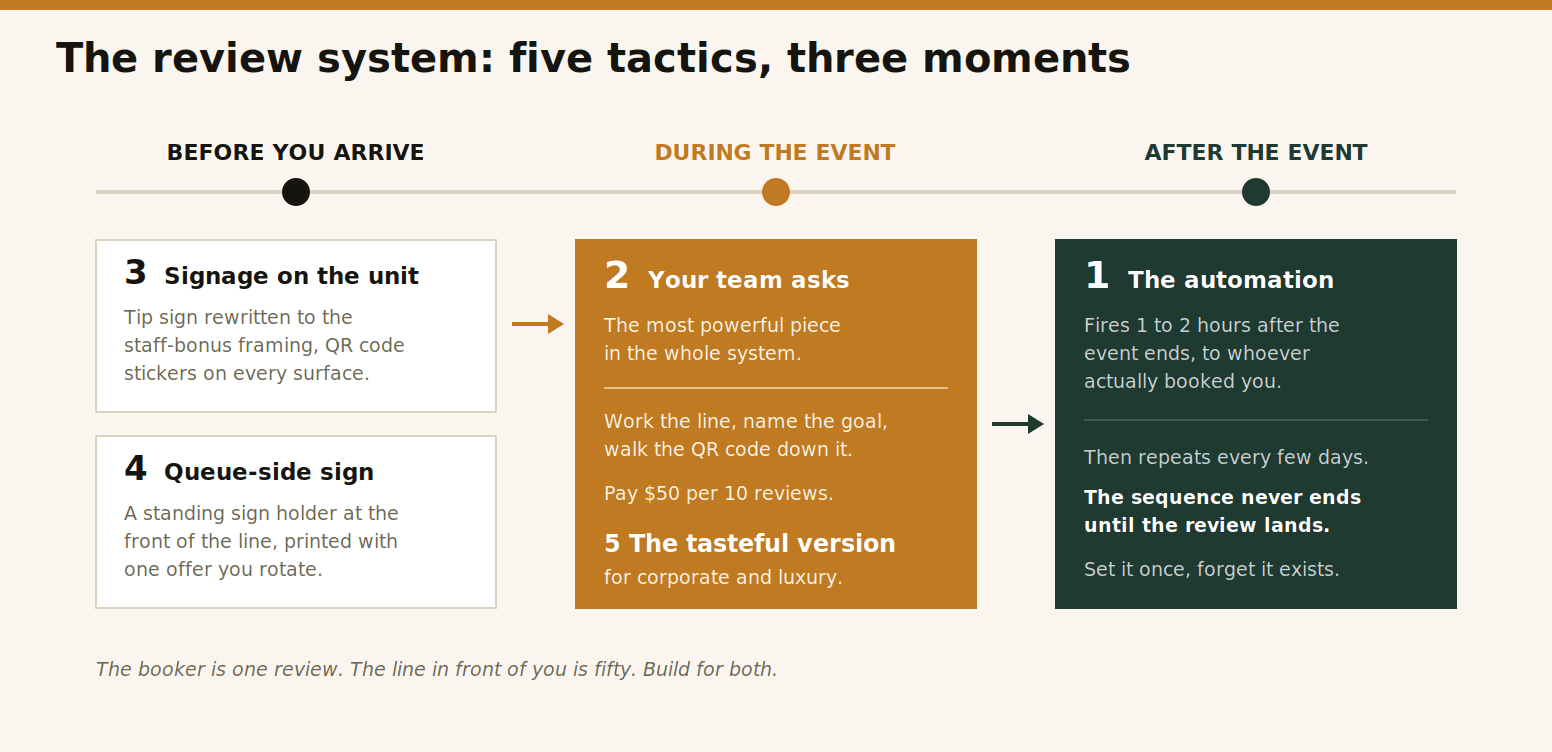
That single rule changes how you should think about asking. You are not running a review campaign. You are building a review acquisition system that produces a steady drip forever, off the back of events you are already working. Here is how to get more Google reviews using five things you can set up this week.
What a review actually needs to contain
Before the tactics, know what you are aiming at. Not every five-star review carries the same weight.
The ideal review has four ingredients plus photos:
| Ingredient | Why it matters |
|---|---|
| The service they booked | Puts your actual service language on your profile |
| Your company name | Reinforces brand and entity signals |
| The service area or city | Does local relevance work a generic review cannot |
| One specific thing they liked | Reads as real to the next buyer, not as a favor |
| Two photos, taken in the Google app | Uploads carry geotag data and photos lift engagement |
A review that reads "set up their custom bar for our launch party in downtown LA and the service was fantastic" is worth several that just say "great, five stars." You cannot dictate what people write, but you can prompt for it, and the tactics below are built to prompt for it.
1. Automate the follow-up to the person who booked you
Most operators are fine at delivering the event and terrible at chasing the organizer afterward. That is the easiest review you will ever get and it is the one that goes missing.
Build the trigger into your booking system or wire it through Zapier so it fires without anyone remembering.
- Send the first email one to two hours after the event ends, while it is still the best thing that happened to them today.
- Keep it plain: we were so glad to serve you, please leave us a five-star Google review, here is the link.
- Do not stop after one send. The sequence follows up every few days and only ends when the review lands.
That last point is the one people skip. A single ask converts a fraction of clients. An endless polite sequence converts most of them. Paid tools like NiceJob do this on a monthly subscription if you would rather not build it yourself.
2. Have your staff ask the line, and pay them for it
This is the most powerful tactic on the list, because the person who booked you is one review and the line in front of your cart, bar or table is fifty.
A friendly team member working the queue at a wedding, with a good attitude, sounds like this: thank you so much for waiting, here is our goal for tonight, we want 10 new five-star reviews, if you can help us out we would be so happy. That is showing excitement, not begging. It works because everyone in that line is already having a good time.
Then make it frictionless. Someone walks the line holding the QR code so guests scan on the spot and land straight in the review form. No searching, no typing.
Pay for it. Give a staff member $50 for every 10 five-star reviews they generate and you will produce hundreds of them. Set the incentive, train the ask with real verbal examples so they know exactly how you want it delivered, and it runs itself.
One more line to teach your staff: ask for the photo. Something playful like "take a photo of me for the review, I want to be the most famous person on our Google page" gets you the two photos you actually want attached.
3. Turn your tip signage into review signage
Everyone already puts a tip sign on the cart. Change what it says.
- "Our employees earn tips through reviews"
- "Our staff get bonused when you leave a review"
Then put the QR code right next to it. That framing converts far better than "leave us a review" because the guest understands exactly who benefits and why it matters.
Stick these on the cart itself so they are working every minute of every event whether or not anyone is asking out loud.
4. Run a small stand at the front of the queue with a trade
Get a small standing sign holder and put it where the line forms, in front of the cart. Print an offer on it and swap the offer until you find what pulls in your market.
Options worth testing:
- Want to unlock a secret menu item? Leave a review.
- Want a free item at our shop? Leave a review. (Easy if you have a bricks-and-mortar location.)
- Want a second serving free? Leave a review.
- Want to tip our team? Leave a review.
People love this stuff, and the stand works on brand activations and pop-ups as well as standard catering. Note the one caveat: Google's own guidelines discourage incentivizing reviewers directly, so the safest version of this tactic is the one where you are paying your own staff, not the guest.
5. Run the tasteful version at corporate and luxury events
The out-loud ask is not always available. At a high-end corporate activation or a luxury brand event, the organizer may not want your staff working the room for reviews, and you should respect that.
Shift to subtle capture instead:
- One-on-one conversations with the guests you genuinely connect with, no announcements.
- A review card on the counter.
- An RFID tap-to-review sticker, where the guest holds their phone near the cart and the review link opens.
- A plain QR sticker on the cart, with the staff-bonus line on it.
Same system, quieter delivery. You still collect, you just never make it the client's problem.
Your review system checklist
Print this and work down it once. It is a setup job, not an ongoing chore.
- Post-event email automation live, first send at 1 to 2 hours, follow-ups every few days, endless until the review lands
- Google review link shortened and turned into a QR code
- QR stickers printed and stuck on every cart, bar and table
- Tip signage rewritten to the staff-bonus framing
- Queue-side sign holder bought and printed with one offer to test
- Staff bonus set and communicated, for example $50 per 10 five-star reviews
- The verbal ask scripted and rehearsed with every staff member
- Tasteful corporate version agreed so staff know when to switch modes
- Weekly target set: 2 five-star reviews, every week, tracked
Frequently asked questions
How many Google reviews should I be getting per week?
Aim for two five-star reviews per week, sustained. That steady cadence is worth more than a burst of 40 followed by silence, because Google reads ongoing review velocity as a signal the business is currently active and trusted. A consistent drip also protects you, since a single one-star matters far less against a growing count.
Can I offer customers something in exchange for a Google review?
Google's guidelines discourage incentivizing reviewers directly, so the safest structure is incentivizing your own staff rather than the guest. Paying a team member a bonus per five-star review generated is internal compensation. Offering the guest a free item for a review sits closer to the line. Know the distinction and decide where you want to sit.
What is the best time to ask for a review after a catering event?
Within one to two hours of the event ending, and on-site during service for guests. Both moments are peak happiness. Waiting until the next morning means competing with real life, and the further you get from the event the more the ask feels like a chore.
Do Google reviews really matter more than my website for rankings?
For a local service business, they carry disproportionate weight because they live on Google's own platform. Operators with weaker sites and lower authority scores routinely outrank stronger competitors purely on sustained review velocity. Your site still has to convert the traffic, but reviews are what get you seen in the map pack in the first place.
Should I ask guests for photos with their review?
Yes, and specifically ask them to upload from inside the Google app so the photos carry location data. Two photos attached to a review make it more useful to the next buyer and add engagement to your profile. Teach your staff to ask for it in the same breath as the review itself.
Where to start
Pick the automation first, because it runs without anyone at the event doing anything. Get the post-event sequence live this week, then print the QR stickers, then set the staff bonus. That order gets you a baseline immediately and stacks the high-volume tactics on top.
If you want to see how your review cadence and Google visibility actually compare to the caterers you are competing against, run the free Growth Diagnostic. It takes a few minutes and shows you exactly where the gap is.